Bonzofinance liquidations: Bonzo Lend's threshold
Under the documented rules for Bonzo Lend, Bonzo Finance's lending component on Hedera, a borrowing position becomes eligible for liquidation when its health factor falls below 1. During a liquidation, another participant repays debt and receives collateral plus a bonus from the borrower's position.
- Debt repayment limit
- Up to 50% of the borrower's debt during a liquidation under the documented rules.
- Liquidation bonus
- A variable percentage determined by the collateral asset taken, paid to the liquidator through the collateral transfer.
- Recorded lending restriction
- Bonzo Finance Labs' July 11, 2026 incident report records Bonzo Lend's Hedera mainnet pool as paused following an oracle exploit, while conditions for reopening and withdrawals by liquidity providers were being determined.
Reading a declining health factor
Relative prices affect collateral coverage. Collateral losing value against the borrowed assets, or borrowed assets gaining value against the collateral, can push the health factor down. USDC departing from its intended $1 peg can also change this relationship.
A health factor approaching 1 from above leaves less room for another adverse price move. Bonzo Finance's liquidation guidance advises maintaining a buffer well above 1. Crossing below the boundary creates eligibility; the reading alone does not establish that debt has been repaid or collateral transferred.
Repaying debt and adding collateral
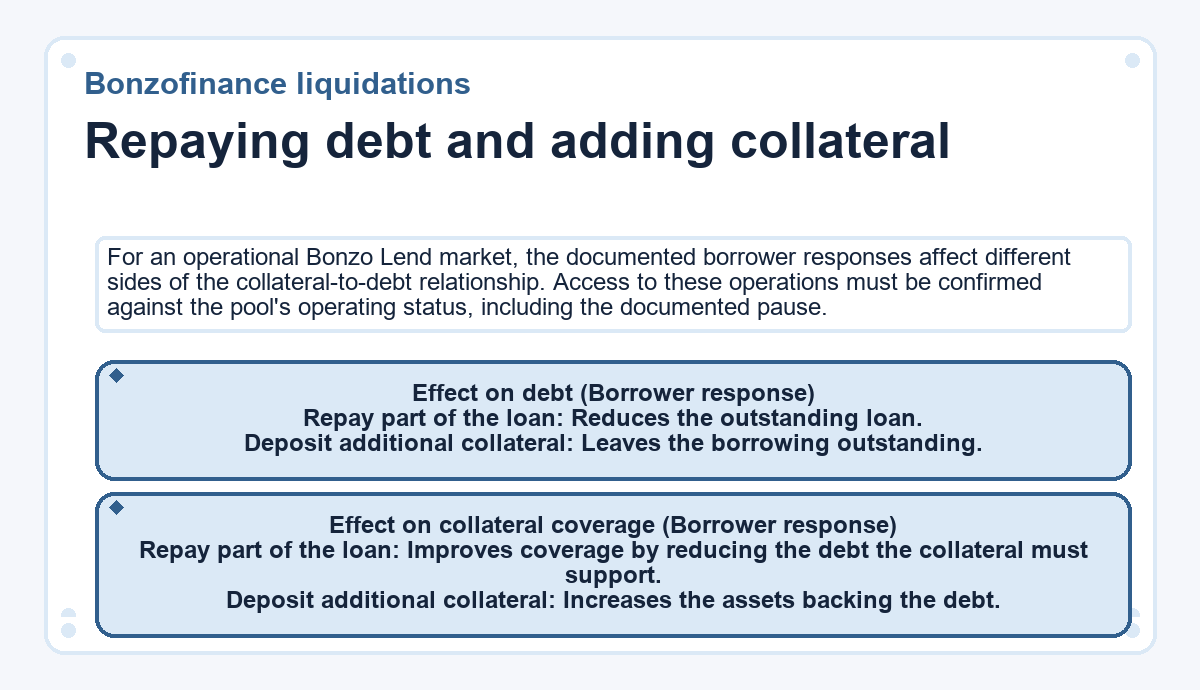
For an operational Bonzo Lend market, the documented borrower responses affect different sides of the collateral-to-debt relationship. Access to these operations must be confirmed against the pool's operating status, including the documented pause.
| Borrower response | Effect on debt | Effect on collateral coverage |
|---|---|---|
| Repay part of the loan | Reduces the outstanding loan. | Improves coverage by reducing the debt the collateral must support. |
| Deposit additional collateral | Leaves the borrowing outstanding. | Increases the assets backing the debt. |
What an executed liquidation changes
The 50% ceiling applies to debt repaid during a liquidation. Any unpaid borrowing remains outstanding. The collateral taken corresponds to the repayment plus the applicable bonus, so the collateral value surrendered exceeds the debt value repaid.
With several collateral assets in a position, a liquidator can choose which collateral to claim, taking its bonus into account. The applicable percentage therefore follows the collateral asset taken. Bonzo Finance's liquidation documentation directs users to each asset's analytics for that percentage.
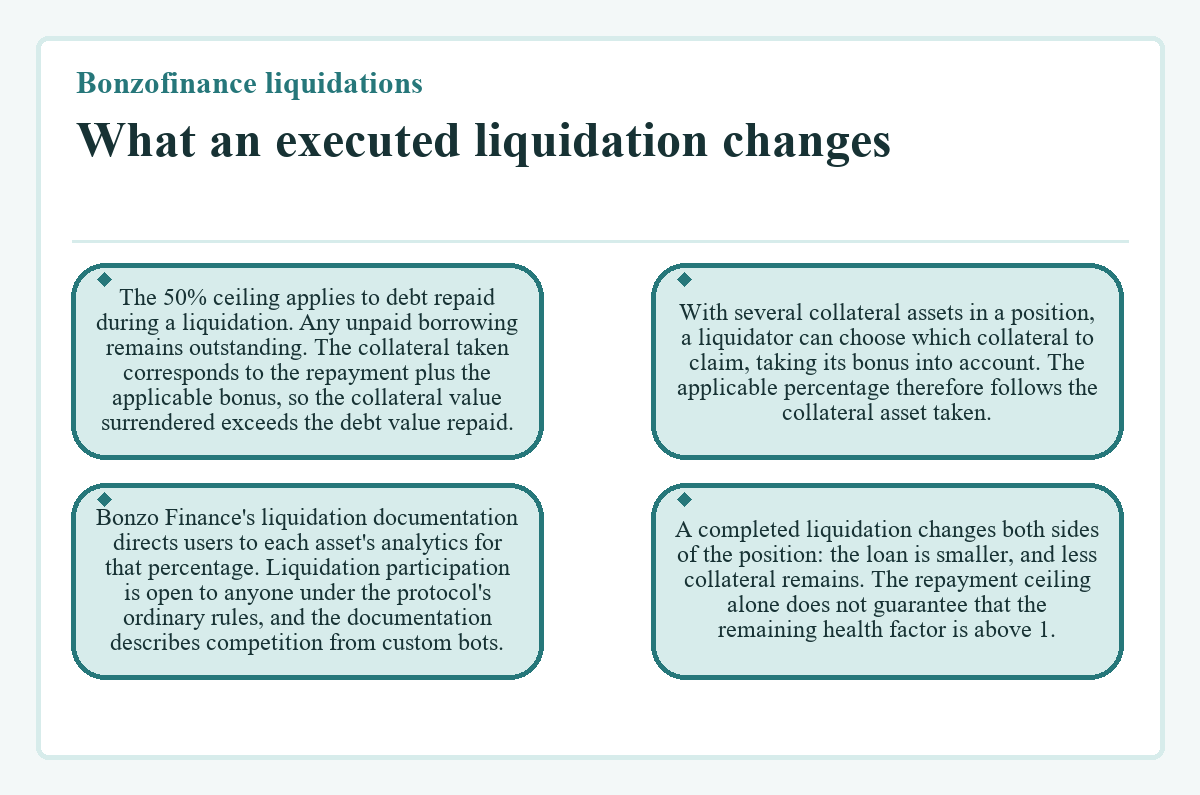
Liquidation participation is open to anyone under the protocol's ordinary rules, and the documentation describes competition from custom bots. A completed liquidation changes both sides of the position: the loan is smaller, and less collateral remains. The repayment ceiling alone does not guarantee that the remaining health factor is above 1.
Liquidations during the oracle incident
Bonzo Finance Labs' July 11, 2026 incident report describes Supra's oracle verifier accepting a manipulated SAUCE price denominated in HBAR on Hedera mainnet. According to the report, SAUCE's actual market price did not move, while Bonzo Lend computed collateral values from the compromised stored price.
The recovery update Bonzo Finance Labs published on October 30, 2026 includes accounts affected by liquidations during the exploit window. Its calculation nets borrowing against supplied assets at pre-exploit prices and accounts for repayments and withdrawals made after the position snapshot.
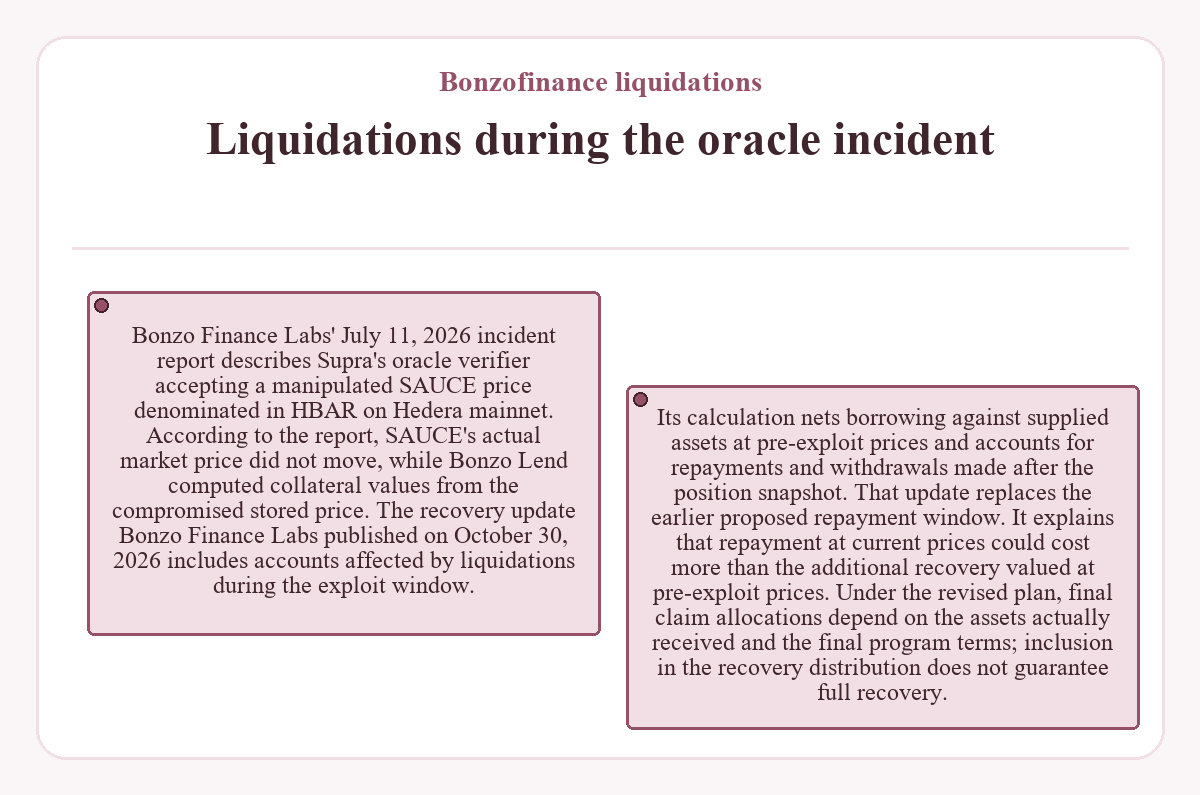
That update replaces the earlier proposed repayment window. It explains that repayment at current prices could cost more than the additional recovery valued at pre-exploit prices. Under the revised plan, final claim allocations depend on the assets actually received and the final program terms; inclusion in the recovery distribution does not guarantee full recovery.
updated